Grading Explained: Cards, Coins and Stamps
Three hobbies, three grading systems, one underlying idea — replacing the seller’s opinion with an independent one.
Third-party grading solved a problem every collectible market has: the person who owns the item is the person describing its condition, and they are not a neutral party. An independent grader who never owns the item and is paid the same regardless of the outcome removes that conflict, and the market prices the result accordingly.
The mechanics differ by hobby, but the reasoning is the same everywhere it has taken hold.
The three systems
- Trading cards — 1 to 10
- PSA, BGS and CGC assess centring, corners, edges and surface, then seal the card in a tamper-evident holder with the grade on the label. A 10 means gem mint. The jump from 9 to 10 is frequently the largest price step in the entire scale, because it is the hardest to achieve consistently.
- Coins — the Sheldon scale, 1 to 70
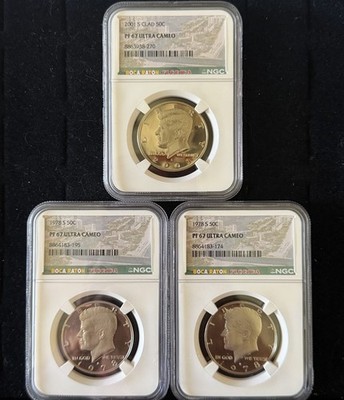
- PCGS and NGC grade on a seventy-point scale, where 60 and above denotes an uncirculated coin and 70 is flawless under magnification. Far more granular than the card scale, which suits a market where a single point can change the price substantially.
- Stamps — expertisation and numeric grading
- Philately's older tradition is a certificate of genuineness rather than a numeric grade: the stamp is confirmed as authentic and unaltered. Numeric grading of centring and condition exists alongside it, but authentication has always been the primary concern, because forgery is the field's oldest problem.
Population reports, and why they matter
Graders publish how many examples of each item they have certified at each grade. That census turns a vague sense of scarcity into a number: if a card has been graded five thousand times and only forty came back as a 10, the difficulty is documented rather than asserted.
It is also why "graded higher" is often a more useful figure than the population at your own grade. A card with nothing above it sits at the top of the known census regardless of how many exist in total — and that, rather than raw age or print run, is what a serious buyer is actually paying for.
Graded and certified coins
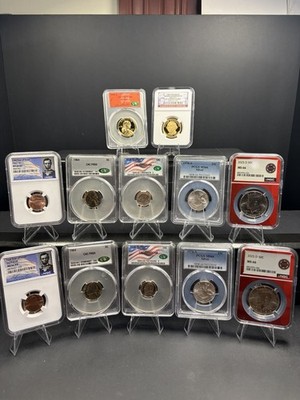
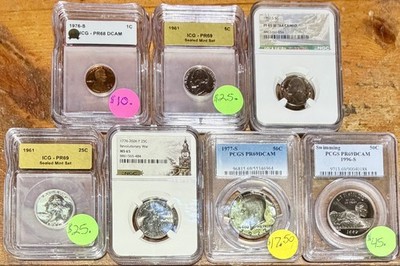
PCGS and NGC slabs, where the grade is already settled and the price reflects it.